
US flags Chinas IP theft as security threat
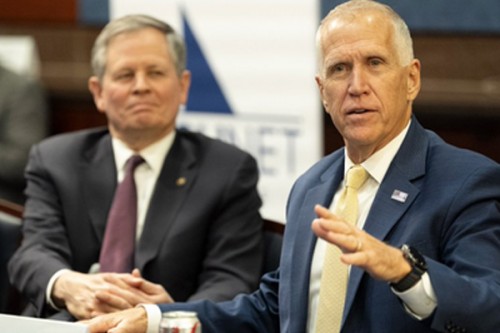
Washington, April 25 (IANS) US lawmakers from both parties warned that China’s alleged large-scale theft of American intellectual property poses a growing threat to national security, economic competitiveness and technological leadership, during a Senate Judiciary Committee hearing that sharply underscored rising tensions in the innovation race.
Senator Thom Tillis said the economic loss from China’s intellectual property (IP) theft is estimated at “between 400 and $600 billion a year,” adding that Beijing’s broader aim is “to undermine US leadership, to assume the title of world’s innovation leader.” He stressed that “innovation and creativity are critical… to our national security.”
Senator Richard Durbin echoed concerns about China’s methods, saying it has engaged in “economic espionage and IP theft to steal work that may have taken many years to develop,” at a cost of “between 225 and $600 billion every single year.” He added that such practices reduce incentives for US companies to invest in research and development.
Former CIA officer Tom Lyons said American firms are “not competing against Chinese rivals in any normal sense,” but “against the largest intelligence apparatus in the world.” He warned that companies face “the wholesale transfer of American industry to our adversary” if current trends persist.
Lyons cited multiple cases of alleged theft, including the case of Linwei Ding, who “stole Google’s latest generation TPU designs,” noting that “the technology is gone and we will only see the consequence of that in several years.” He added that “the occasional DOJ conviction does not unsteal the technology.”
Helen Toner of Georgetown University highlighted vulnerabilities in artificial intelligence, calling “distillation” — a method where advanced AI models are used to improve less advanced ones — “a real threat to US AI competitiveness.” She said Chinese firms are “distilling from American models at large scale,” but warned against focusing solely on one risk while ignoring broader threats to AI systems, data and hardware.
Toner also pointed to recent breaches, noting that “hackers breached OpenAI’s internal communication systems” and extracted “algorithmic secrets,” while other incidents involved theft of training data and hardware-related information. She said there is “no shortage of ways in which US innovation in AI is vulnerable.”
Mark Cohen, a veteran IP expert, cautioned that US policy responses have been overly focused on criminal enforcement rather than systemic issues. He said China’s IP system is “state driven” and used “as a tool of industrial policy,” backed by scale, speed and extensive government support.
At the same time, Cohen warned that China is no longer merely copying. “China is not only copying. It is increasingly innovating,” he said, adding that it could soon become a global “norm setter in intellectual property.”
Lawmakers raised concerns ranging from semiconductor exports to AI competition and biotech espionage. Several warned that weakened US institutions and inconsistent policies risk giving China an edge. Toner stressed that restricting access to advanced computing power remains “the best lever that we have in AI competition with China.”
The hearing highlighted growing bipartisan agreement that the challenge extends beyond economic losses. As Lyons put it, the issue represents “a national security failure.”

|

|